

If you are wondering where to go when visiting Hanoi, make sure to visit the Temple of Literature – Imperial Academy. This is the first university in Vietnam and a place that preserves the cultural and historical heritage of Hanoi, a capital with a thousand years of civilization. Let’s explore more about the Temple of Literature – Imperial Academy through the information below.
1. Introduction to the Temple of Literature – Imperial Academy
Location of the Temple of Literature – Imperial Academy
The Temple of Literature – Imperial Academy is located at 58 Quoc Tu Giam Street, Dong Da District, Hanoi, less than 2 km from Hoan Kiem Lake and Hanoi’s Old Quarter. Thanks to its central location in the capital, the site is very convenient to visit as part of a cultural sightseeing itinerary that includes famous attractions such as the Imperial Citadel of Thang Long, the Ho Chi Minh Mausoleum, and the National Assembly Office.
History
When was the Temple of Literature – Imperial Academy established? The complex was built in 1070, during the reign of King Ly Thanh Tong. Initially, it was a place of worship dedicated to the Four Worthies, Confucius, and the Duke of Zhou. In 1076, King Ly Nhan Tong established the Imperial Academy right next to it as a place of education for the king’s children and members of noble families.
During the reign of King Tran Thai Tong, the institution was renamed the Quoc Hoc Vien (National Academy) and began accepting talented children from ordinary families as well. Under King Le Thanh Tong, steles honoring successful doctoral graduates began to be erected at the site.
During the Nguyen Dynasty, another Imperial Academy was established in Hue. The Temple of Literature was renovated and later renamed the Temple of Literature of Hanoi. In 1947, French colonial forces fired artillery at the site, causing one of the buildings to collapse. Only the foundation, two columns, and four stone ink slabs remained.
Opening Hours & Entrance Tickets
This historical and cultural site in Hanoi is open every day from 8:00 AM to 5:00 PM. Visitors are required to purchase and present an entrance ticket at the ticket checkpoint.
2. Unique Architecture of the Temple of Literature – Imperial Academy
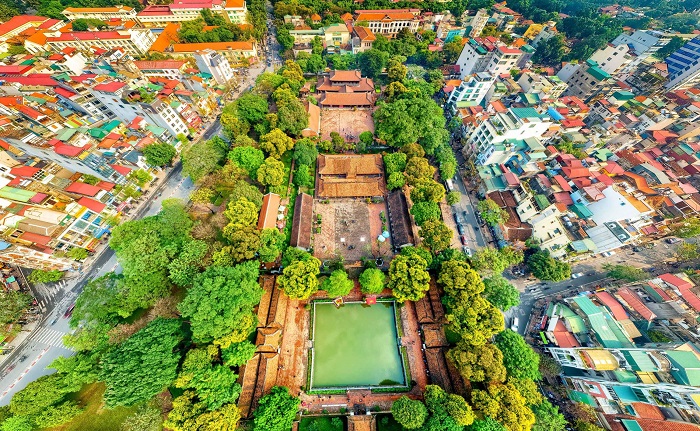
The historical complex covers an area of approximately 54,331 m² and includes various structures such as the Temple of Literature, Van Lake, the Imperial Academy, Khue Van Cac, and Giam Garden. The complex is surrounded by old brick walls marked by the passage of time.
The architecture strongly reflects the style of royal architecture from the early Nguyen Dynasty. The main areas of the Temple of Literature are arranged symmetrically, with each section and layer following the traditional north-south axis.
The layout of the Temple of Literature – Imperial Academy consists of five main areas, separated by walls and gates:
The first area: Begins at the main gate, Van Mieu Mon, and extends to Dai Trung Mon. On both sides are two smaller gates, Dat Tai Mon and Thanh Duc Mon.
The second area: Extends from Dai Trung Mon to Khue Van Cac.
The third area: Includes Thien Quang Well, also known as the Well of Heavenly Light.
The fourth area: The central area consists of two major buildings arranged in sequence. The inner building is the Thuong Cung, while the outer building is the Bai Duong.
The fifth area: The Thai Hoc area, rebuilt in 1999. Previously, this was the Khai Thanh Temple, which was dedicated to the parents of Confucius but was later destroyed.
3. Outstanding Structures Inside the Temple of Literature – Imperial Academy
3.1 Van Mieu Mon
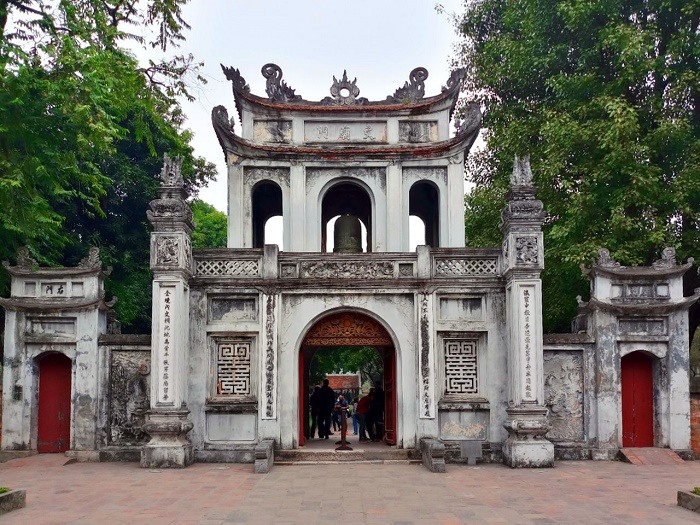
Van Mieu Mon is the outer three-entrance gate of the historical complex and has a solemn and dignified appearance. The structure consists of three entrances and two levels. The upper level bears the three Chinese characters “Van Mieu Mon” in ancient Chinese script.
In front of the gate are two stone steles on either side, together with four ceremonial pillars in the center.
3.2 Van Lake and Giam Garden
Van Lake, also known as Giam Lake or Minh Duong Lake, is located directly in front of the entrance to the historical complex. The lake covers a relatively large area, with Kim Chau Islet located in the middle.
On the islet stands Phan Thuy Duong, a place where scholars in the past held literary discussions.
Giam Garden is located along the western wall of the Temple of Literature. It features an octagonal house, ornamental trees, a pond, and various other landscaped areas. The garden provides a pleasant place for sightseeing, relaxation, and cultural activities.
3.3 Dai Trung Mon
Dai Trung Mon is the second gate of the Temple of Literature – Imperial Academy. The structure consists of three compartments, built on a raised brick foundation with curved-tile roofing designed in the style of traditional Vietnamese communal houses.
The areas in front of and behind Dai Trung Mon are spacious, featuring parallel pathways, greenery, and ponds. As a result, this area offers a peaceful and elegant atmosphere in the middle of bustling Hanoi.
3.4 Khue Van Cac
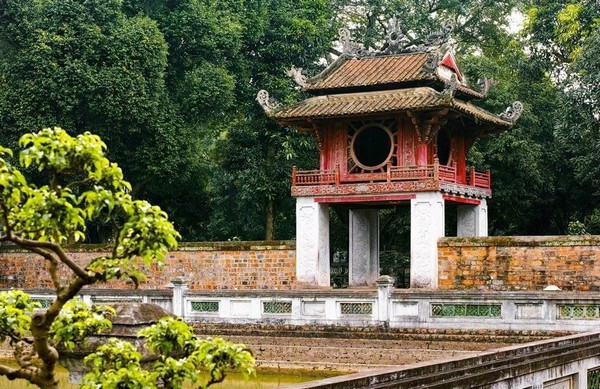
In 1805, Khue Van Cac at the Temple of Literature – Imperial Academy was built by Nguyen Van Thanh, the Governor-General of Hanoi, during the Nguyen Dynasty.
It is a square pavilion with eight roofs, nearly nine thuoc high, consisting of four upper roofs and four lower roofs. Khue Van Cac stands on a square foundation, with each side measuring approximately 6.8 meters, and is particularly impressive for its unique ancient pavilion architecture.
The upper level is decorated in red lacquer and gilded details, with two layers of red tiled roofs stacked on top of each other. The lower level consists of four square brick pillars intricately decorated with ornamental patterns.
The round windows on the upper floor create a distinctive feature, resembling the Khue star, which symbolizes the shining light of knowledge.
3.5 Doctoral Stele Garden and Thien Quang Well
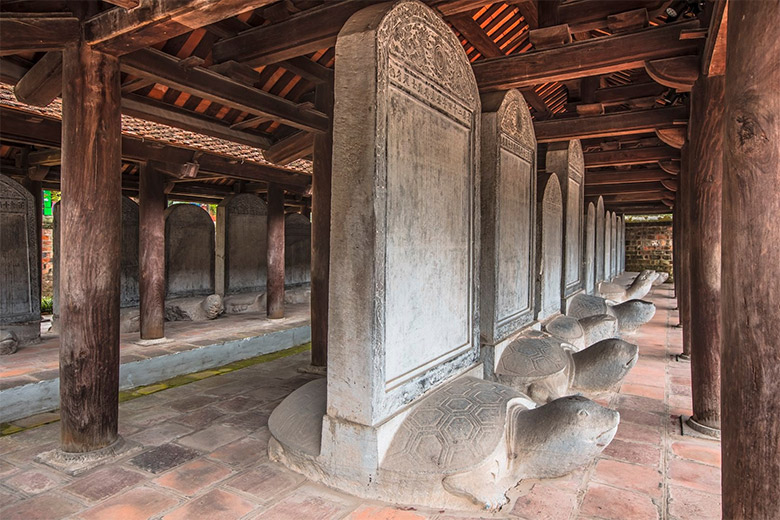
The Doctoral Stele Garden is one of the must-see attractions when visiting the historical complex.
The 82 steles of the Temple of Literature – Imperial Academy are highly intricate works of stone carving with spiritual significance. The steles are placed on the backs of stone turtles, and they record information about 82 top-ranking doctoral graduates from different dynasties in Vietnamese history.
On March 9, 2010, the 82 stone steles were recognized by UNESCO as a World Documentary Heritage.
Thien Quang Well, also known as Ao Van, is located behind Khue Van Cac and next to the Doctoral Stele area. The square-shaped well symbolizes the earth. It was designed as a place to receive the essence of the universe and illuminate knowledge.
3.6 Dai Thanh Hall
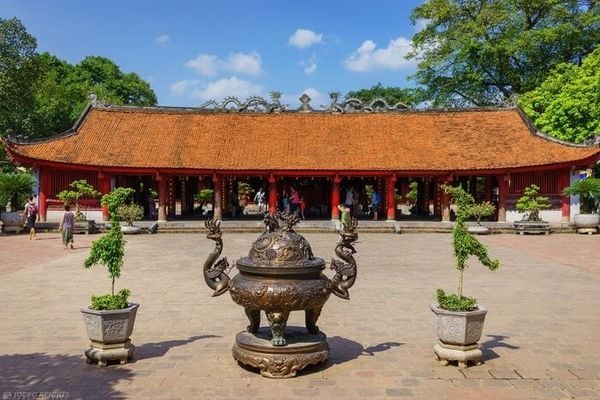
Dai Thanh Hall is located in the fourth section of the historical complex. In the center is Dai Bai Courtyard, with two rows of buildings extending along the eastern and western sides.
The building at the front is Bai Duong, where ceremonies honoring Confucius were held in the past.
Dai Thanh Hall and Bai Duong run parallel to each other and are connected by a small pavilion. The structure consists of nine compartments and has enclosed walls on three sides.
Dai Thanh Hall is dedicated to Confucius, the Ten Philosophers, and the Four Worthies.