

1. Introduction
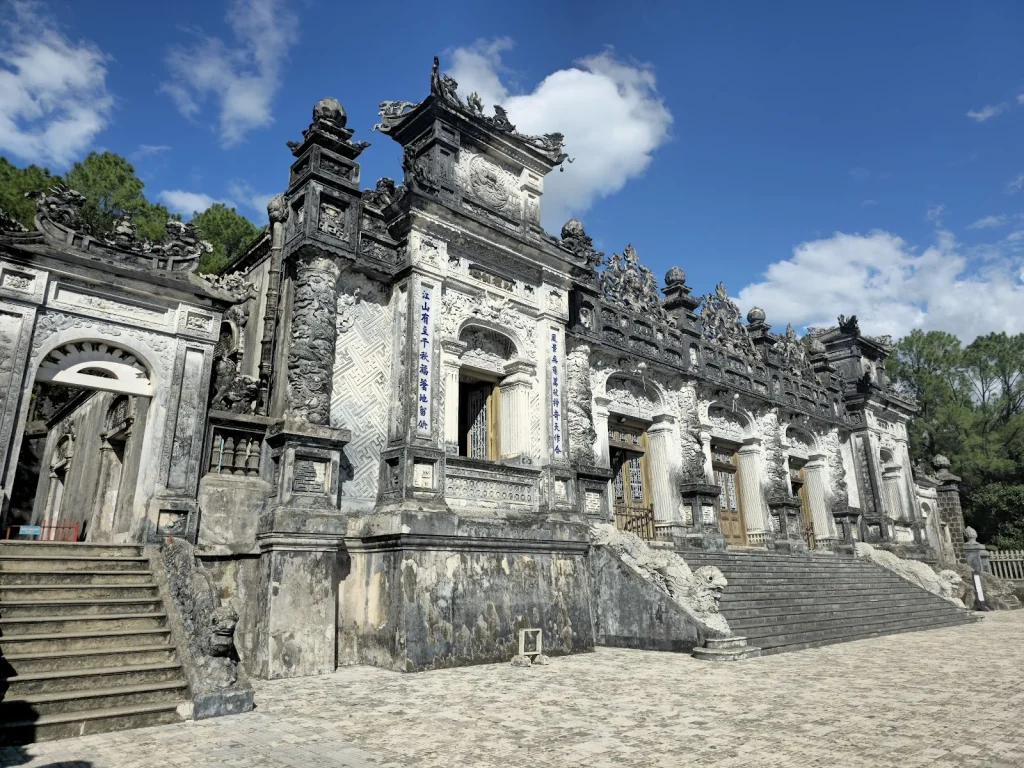
The Tomb of King Khai Dinh, formally known as Ung Lang, is the final resting place of King Khai Dinh (1885–1925), the 12th monarch of the Nguyen Dynasty. Situated on Chau Chu Mountain—now part of Thuy Xuan Ward, Hue City—the tomb lies approximately 10 km from the city center. Compared to the tombs of earlier Nguyen kings, Khai Dinh’s tomb is smaller in area but features a dense architectural layout and highly elaborate ornamentation. The entire complex measures roughly 117 meters in length and 48.5 meters in width, arranged along a vertical axis on the mountainside, with 127 steps leading up to the Thien Dinh Palace.
A distinctive feature of Ung Lang is its fusion of traditional Vietnamese architecture with significant influences from Europe and other Eastern cultures. In addition to traditional materials, the structure incorporates iron, steel, cement, and French slate tiles, alongside various types of ceramics and colored glass for decoration.
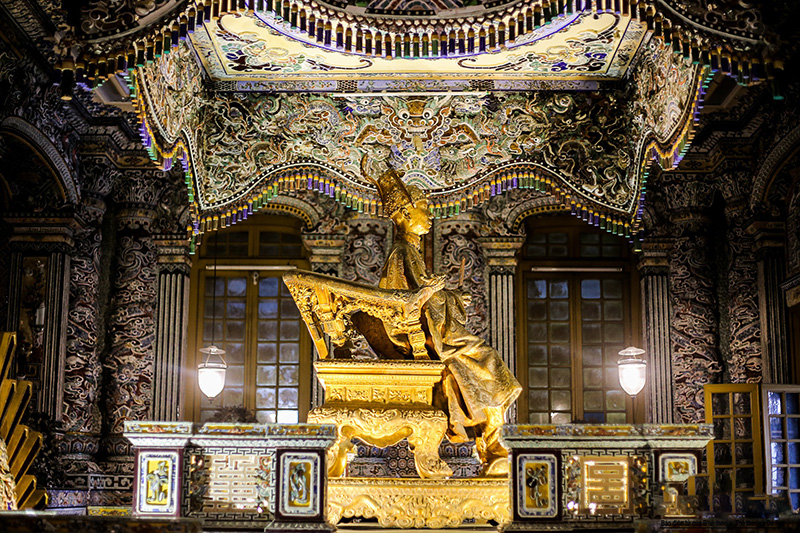
The centerpiece of the complex is the Thien Dinh Palace, which houses the bronze statue and tomb of King Khai Dinh, the royal canopy, and numerous works of painting, sculpture, and ceramic mosaic art. Notably, the “Nine Dragons Hidden in Clouds” fresco on the ceiling of Khai Thanh Palace is one of the tomb’s most celebrated artworks.
2. History of Construction
King Khai Dinh ascended the throne in 1916. After selecting Chau Chu Mountain as the site for his mausoleum, the King renamed the mountain Ung Son; consequently, the tomb became known as Ung Lang.
Construction of the tomb was undertaken under the supervision of Le Van Ba—Commander-in-Chief of the Vanguard Army—and involved the participation of numerous artisans and craftsmen. To construct and decorate the structure, the imperial court imported various materials from abroad—including iron, steel, cement, and French slate tiles—while porcelain and colored glass were used for interior decorative elements. King Khai Dinh passed away on November 6, 1925, and was laid to rest at Ung Lang. Construction continued under the reign of King Bao Dai and was completed in 1931.
3. Architecture
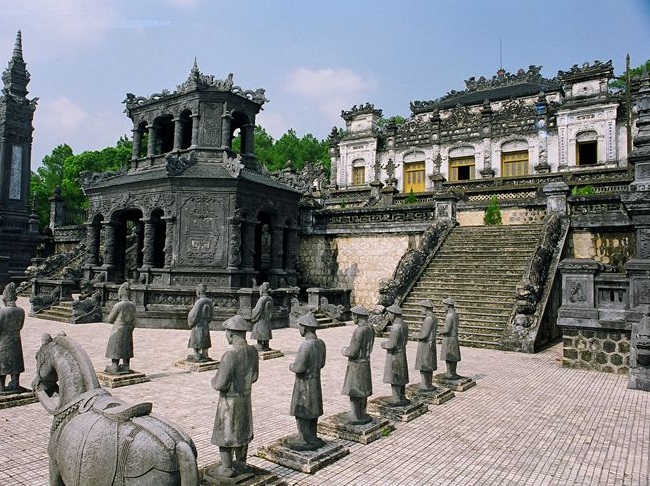
The Tomb of Khai Dinh was constructed on Chau Chu Mountain; due to the steep terrain, the entire complex is organized along a vertical axis, ascending from the lowest to the highest point. The various levels are connected by staircases featuring dragon carvings, complemented by balustrades with pillar-like posts and intricate decorative patterns. The structure utilizes imported materials—such as concrete, reinforced steel, stone, and ceramics—creating an appearance that is both robust and exquisitely refined. The layout is clearly defined, progressing from the entrance gate to the Thien Dinh Palace. Thien Dinh Palace is considered the main architectural structure of the mausoleum and serves as the burial site for King Khai Dinh. The palace features a unique design comprising five interconnected sections: the Left and Right Guard Chambers on either side, Khai Thanh Hall, and the central Buu Tan (Precious Canopy). The statue of the King and the tomb itself are situated beneath this structure.
The architecture of Thien Dinh Palace is remarkable, blending traditional styles with modern elements. The palace is adorned with intricate mosaics crafted from glass and ceramics imported from Japan and China.
The architecture of Khai Dinh’s tomb represents a fusion of diverse elements. Alongside traditional Vietnamese imperial architecture, the structure incorporates details influenced by Romanesque, Gothic, Hindu, and Buddhist architectural styles.
European influences are evident in the forms of the archways, columns, and balustrades, as well as in the handling of architectural massing. Meanwhile, motifs such as dragons, phoenixes, floral patterns, and Chinese characters—along with the ceremonial arrangements—retain the distinct characteristics of Eastern imperial art.
This combination gives Ung Lang (Khai Dinh’s Tomb) a unique appearance that sets it apart from the Nguyen Dynasty royal tombs built previously.
4. Artistic Value
The outstanding artistic value of Ung Lang lies primarily in the decorative art of the Thien Dinh Palace. Here, architecture, sculpture, painting, and ceramic mosaic work converge within a single space.
The ceramic and colored glass mosaics feature a rich palette and diverse themes, arranged in dense, intricate patterns. This technique required artisans to meticulously select, cut, and assemble individual fragments according to precise shapes, colors, and placements.
Complementing the mosaics are the bronze statue of King Khai Dinh, the ceremonial canopy, and the “Nine Dragons Hidden in Clouds” mural. These masterpieces contribute to the distinctive artistic significance of the Thien Dinh Palace and the tomb complex as a whole. Consequently, the Tomb of Khai Dinh is regarded as a prime example of the art of ceramic and glass mosaic in early 20th-century Vietnam, while also clearly reflecting the cultural fusion found in the royal architecture of the late Nguyen Dynasty.
5. Tourist attractions near Khai Dinh Tomb in Hue
When visiting Khai Dinh Tomb in Hue, you can combine your trip with visits to several nearby attractions to gain a deeper understanding of the ancient capital, such as:
• Minh Mang Tomb
• Thien An Monastery
• Thuy Tien Lake
• Thieu Tri Tomb
• Tu Duc Tomb
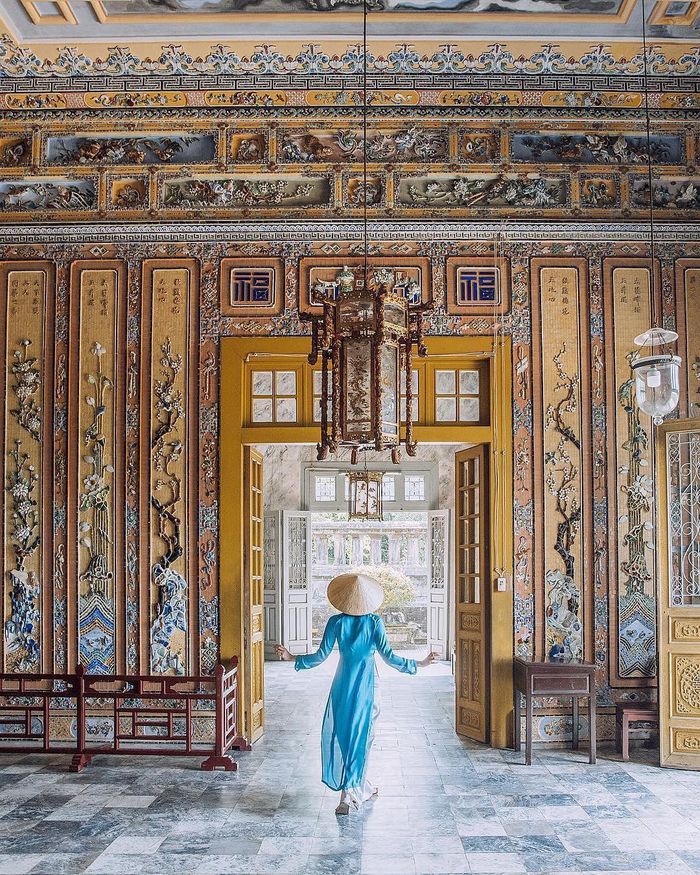
With its rich artistic features, the Tomb of Khai Dinh is a popular destination for both domestic and international tourists. It is a captivating site that you simply cannot miss when visiting Hue. Hopefully, the information in this article helps you gain a deeper understanding of this architectural landmark.